August 27, 2014

Bid my dear and loving wife adieu

The War of 1812 separated loved ones, causing anxiety for those who did not know if their loved ones would return. One couple that found the war disruptive to their relationship was British Lieutenant Maurice Nowlan and his wife Agathe. Maurice and Agathe were newlyweds who were separated by the war after only six months of marriage.

Maurice wrote that he most enjoyed being alone reading Agathe letters than amongst the jovial society functions. Although Maurice longed for his wife, he firmly believed that a military camp was no place for a woman. Agathe was desperate for letters from Maurice and complained that she did not hear from him as much as she liked.
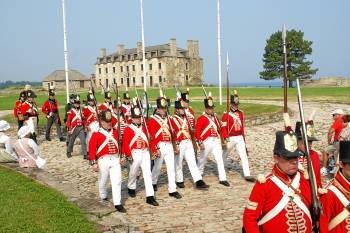
British soldiers at Fort Niagara
The couple’s situation became worse when Maurice’s regiment, the 100th Foot, was transferred to the Niagara in autumn of 1813. As their distance grew, Maurice wrote “Nothing on Earth could give me more pleasure than to have the infinite happiness of pressing you to my Heart.” During their separation, Maurice attempted to reassure his wife by writing “Try to be a little more patient,” while asking, “what can I do my dear so far away?”

On December 10, 1813, Lieutenant Nowlan was about to take part in the night attack on Fort Niagara. Although his was confident that he would survive, Maurice found it difficult “to bid my dear and loving wife adieu and perhaps the last time.” He went on to write,

My dearest jewel don’t torture yourself with grief if you should chance to get this before I have time to write you again. Hope for the best, my only Heart. You know you are my only care, it’s but for you I live, may the Almighty bless you, my only wife.

Sadly, Maurice was killed in action during the attack. There is no record of how Agathe coped with her husband’s death but she could take small comfort in knowing that she was loved by a devoted and brave officer.

This weekend head out to Old Fort Niagara for their annual 1812 encampment. You can find out more about Fort Niagara’s role during the war with activities happening during the day, and at night with the British storming the fort. Click here for more information.

August 20, 2014

For honour’s sake

At the start of the War of 1812, the U.S. officer corps lacked combat experience and many American officers were lawyers, merchants and clerks in commercial society. Winfield Scott described most of his fellow officers in 1812 as “imbeciles and ignoramuses.”

This crop of new officers came with an extreme sense of honour and many American officers would “devote every thing to the service of his country, except his honor.” This new officer corps readily insulted others and quickly felt slighted compared to their British counterparts who had a keen sense of duty and their place in class hierarchy.

For the Americans, the newspapers were another important battleground as they published accounts of battles as well as battle reports from commanders. These reports invariably cast the best possible light on the commanding officer, since they were the ones writing them, and on their favoured subordinates. Officer who felt slighted by these reports submitted letters to the newspapers, which often created rivalries and feuds.
Militia Officer, New York State

The winter season provided a great opportunity for officer to secure furloughs for leave to Washington in order to advance their own interests. In March 1814, one congressman wrote, “So great has been the resort of epaulettes here that many have inquired who were left with the Troops?” Leaving the troops behind squandered a great opportunity to train the troops, who resented the fact that they could not go home.

Courts-martial were far more abundant in the American army than in the British. Many officers pressed charges against one another, causing General George Izard to lament, “It is wonderful how much valuable time these Courts Martial engross.” Of course duelling was another way to settle disputes between officers.

Although duelling was prohibited in the U.S. Army, it did take place and some generals even encouraged this practice. With honour as a paramount concern, duellists shot at each other instead of the enemy. In the spring of 1813, two officers crossed the Niagara River to duel in order to leave New York’s legal jurisdiction, but were taken by surprise by the British and captured. At Fort George in 1813, Lieutenant Smith killed Dr. Shumate in a duel, depriving the camp of a much-needed surgeon during epidemics of malaria and dysentery.

Politics, war and honour proved a bloody mix for officers, since fighting each other was easier than fighting the British. Although the American officers retained their sense of honour as a paramount concern, their officer corps did improve during the war. By the time of the Niagara 1814 campaign, younger energetic officer took over and focused on training their men for the task at hand. A renewed sense of duty and training ensured that the Niagara 1814 campaign was the most successful for the American Army during the War of 1812.

This weekend you can head to Fort George for their annual timeline event with interpreters and animators representing the War of 1812, WWI, WWII and more. Click here for details.

August 13, 2014

From Garryowen and glory

The song Garryowen today is best associated with the U.S. Civil War and later as the regimental marching song for George Custer’s Seventh Calvary. The song actually originates from the Irish city of Limerick in the 1780s.

Garryowen was sung by a gang of wealthy troublemakers who enjoyed drinking in the popular and fashionable Limerick suburb of Garryowen (translated as “the garden of John”). The young hooligans enjoyed smashing property that did not belong to them. The song eventually became popular in the British Army since many Irishmen were recruited. During the wars with France between 1793-1815, Garryowen became the second most popular song in the British Army, after British Grenadiers. 

The lyrics for Garryowen:

            Let Bacchus’s sons be not dismayed,
            But join with me each jovial blade,
            Come, booze and sing and lend me aid,
            To help me with the chorus.
                        Instead of spa we’ll drink down ale,
                        And pay the reckoning on the nail,
                        For debt no man shall go to jail,
                        From Garryowen and glory.

            We’ll break windows, we’ll break doors,
            The watch knock down by threes and fours,
            Then let the doctors work their cures,
            And tinker up our bruises.
                        Instead of spa we’ll drink down ale, etc.

            Our hearts so stout have got us fame,
            For soon ‘tis known form whence we came,
            Where’er we go they dread the name,
            Of Garryowen in glory.
Instead of spa we’ll drink down ale, etc.

If you want to hear this song and many more, head out to the annual Fife and Drum Muster and Soldiers’ Field Day this weekend. Fife and Drum corps and infantry units from historic sites across Canada and the U.S. will be at Fort George. Click here for more information.


August 06, 2014

Brilliant achievement – Commander Dobbs’s raid

Only a short distance away from Fort Erie, Lieutenant-General Drummond faced a tough situation with supply lines becoming stretched due to the renewed American presence on Lake Ontario, forcing supplies to be diverted around the lake. Commander Alexander Dobbs of the Royal Navy found that his usefulness on Lake Ontario was now limited and he decided to move his forces to Fort Erie to assist Drummond.

Dobbs joined the Royal Navy as a midshipman at the age of 13 and saw service in the Mediterranean and Atlantic before coming to North America. At the age of 30, Dobbs was promoted to Commander in February 1814 and in the same month, he married Mary Cartwright, the daughter of Richard Cartwright of Kingston who was a prominent merchant and political figure in Upper Canada.

Dobbs assembled a force of 70 seamen and marries to capture three American vessels near Fort Erie. His small force portaged from Queenston to Chippawa where five boats and a gig were loaded onto wagons and transported eight miles around the American position at Fort Erie.
Fort Erie in peacetime

On August 11, 1814, one day before Dobbs launched his attack, a deserter from the De Watteville Regiment swam across the Niagara River and told the Americans of Dobbs’s plan. Colonel George McFeely in command at Black Rock warned Lieutenant Augustus Conckling, captain of the USS Ohio, of the impending attack. McFeely noted that Conckling did not take the threat seriously and that he, “scarcely condescended to listen, turned on his heel and said he would desire no better fun than to see twenty or thirty boats coming to take him.” Conckling did not have to wait long to get his wish.

On the evening of August 12 Dobbs began his mission. As his force approached one of the American schooners, a sentry hailed them, but the British force replied that they were provision boats. An American officer reported that this “deceived the Officer of the Deck, as our Army boats have been in the habit of passing, and repassing throughout the night.” In a few minutes, Dobbs’s men boarded the Ohio and Somers quickly capturing the vessels. A third vessel, USS Porcupine, cut its cable and escaped.

At the cost of only two killed and two wounded Dobbs managed to capture, as reported by Lieutenant Mermet of the De Watteville Regiment, “a long 18-pounder gun – two long 12-pound guns – munitions, two pretty Schooners, five naval officers and seventy-five sailors.” Lieutenant Conckling was also wounded and captured during the operation, a fact that Colonel McFeely was not entirely displeased with reporting that Conckling was taken prisoner before “he got on his clothes.”

Drummond issued a general order praising Dobbs and his men for their “brilliant achievement” and went on to note that he had a mission for the rest of the division. On August 15, 1814, the British launched a three-pronged attack to retake Fort Erie. During the failed attempt, Dobbs commanded a detachment of sailors and marines under the command of Lieutenant-Colonel William Drummond. Dobbs survived the war and went on to serve as the commander at Isle-aux-Noix in late 1814. By 1819, Dobbs was made a post captain but later died in Malta in 1827.

To find out more about Commander Dobbs and the Siege of Fort Erie, head to Old Fort Erie on August 9 & 10 for the 28th Annual Siege of Fort Erie, commemorating the 200th anniversary of the siege. Click here for details.

July 30, 2014

Total want of military command – Conjocta Creek

After the Battle of Lundy’s Lane, the Americans withdrew to their defences at Fort Erie with the British following shortly after. The American position at Fort Erie was not desirable, possessing a position of 800 yards long by 250 yards wide. Porter lamented the American position claiming, “our position is a wretched one.” The American position necessitated an open supply line to resources positioned at Black Rock and Buffalo across the water, a fact that was not lost on Drummond.

Drummond believed that destroying the American supplies would force the enemy to “fight under desperate circumstances or surrendering unconditionally.” Drummond selected 39-year-old Colonel John Tucker of the 41st Foot to launch a raid to destroy the American supplies.  Tucker’s reputation in the Right Division was not very high with soldiers nicknaming him “Brigadier Shindy,” which indicated that Tucker was a “dancing master” who was prone to quarrelling over minor problems.
U.S. Riflemen

Tucker moved his 600 men across the water near Squaw Island just a few miles from Black Rock at about 2 a.m. on August 3, 1814. Tucker did not advance his force until about an hour before daylight. Their advance puzzled John Le Couteur, writing that they moved “without an advanced guard or any apparent precaution.” The British had already lost the element of surprise as the Americans were waiting for them. 

Major Lodowick Morgan of the First U.S. Rifle Regiment was waiting for the British near Conjocta Creek (also known as Scajacuada Creek). Morgan had been a prewar regular, serving as a rifle officer for six years. Morgan spotted the British movement on August 2 on the Canadian side and suspected a forthcoming attack on the American supplies. He ordered his men, about 240 in total, to remove the flooring from the bridge over Conjocta Creek and establish a defensive position.

As the British approached, Morgan waited until they were in within good rifle distance then blew his whistle for the men to open fire. One rifleman wrote that the first volley “completely ‘decapitated’ the head of the approaching column.” The first volley sent the 41st into chaos as the men began to fire without discipline and many ran to the woods to seek cover. Tucker eventually steadied his men and deployed them into line where he exchanged fire with the more accurate American riflemen.

Le Couteur noted that the Americans “shot every Fool that came near the Bridge.” Private Byfield,

received a musket ball, through my left arm, below the elbow. I went into the rear. One of my comrades, seeing that I was badly wounded, cut my [cross] belts from me and let them drop. I walked to the doctor, and desired him to take my arm off. He said it might be cured without it; and ordered me down to a boat, saying, that the wounded men were to cross the river, and they (the doctors) would soon follow.

Tucker continued his duel with the Americans for another hour before retreating to the boats. The results for the British were 12 killed, 17 wounded and 4 missing to the Americans 2 killed and 8 wounded. Le Couteur blamed Tucker’s “total want of military command” for the failure of the mission. Tucker blamed the failed mission on his men, noting to Drummond “the men displayed an unpardonable degree of unsteadiness, without possessing on solitary excuse to justify this want of discipline.”

Drummond was furious about the defeat and on August 5, he issued a strongly worded general order blaming the defeat on “the misbehaviour of the troops employed.” Drummond reminded the officers of the 41st that it was their duty to “punish with death on the spot any man who may be found guilty of misbehaviour before the enemy.”

With the failure at Conjocta Creek, Drummond decided that the best course of action was to lay siege to Fort Erie in order to remove the Americans from that position.

This weekend you can head to Buffalo to find out more about the Battle of Conjocta Creek. Click here for more information. Also, on August 9 & 10 don’t miss the 28th Annual Siege of Fort Erie re-enactment. Click here for more information.  

July 23, 2014

Ketchum’s trap

As the sun began to set at the Battle of Lundy’s Lane Major Thomas Jesup, commanding the Twenty-Fifth U.S. Infantry, saw an opportunity to capture the British guns. A first step in this plan required someone to reconnoitre and secure the road junction leading to the British position.

Jesup choose Captain Daniel Ketchum for this important task. Jesup described Ketchum as “a very good man for the service on which I sent him.” Ketchum recruited his company from Connecticut and was permitted to dress, equip and drill his men as light infantry. Ketchum took his men and moved into the Portage Road where he quickly began to catch individuals and small groups of British and Canadians moving in the dark.

Ketchum managed to catch some high-ranking officers, including General Riall. Riall was hit by a musket ball in the right arm during the battle and as he was riding to the rear of the line, he became caught in Ketchum’s trap. A few minutes later one of Drummond’s aides, Captain Robert Loring, was caught attempting to ride through the junction with orders for the dragoons. 
Battle of Lundy's Lane commemoration, 1914

The next person to enter the trap was William Hamilton Merritt as he was making his way to report to Drummond. When Merritt failed to report his friend Captain John Clark, an adjutant in the Lincoln Militia, was sent to retrieve him when he became caught in the trap. After taking a few more prisoners, the aptly named Ketchum rejoined Jesup in the main body of the Twenty-Fifth.

Jesup now had a problem; what was he to do with the nearly dozen officers and over a hundred men captured. Riall asked to be paroled so that he could visit his own surgeon but Jesup said he had no power to grant such a request. At the same time, Jesup’s men began to cut the prisoners suspenders so that they would be forced to hold their pants, making it difficult for them to escape.

As the prisoners were loosing their suspenders, a British officer rode out of the darkness to Riall, saying, “General Drummond is impatient for information.” The officer was quickly taken prisoner. Ketchum took his prisoners to the rear when he stumbled into a British unit that opened fire, causing Ketchum to loose a number of prisoners but he retained the captured officers. Ketchum despotised the prisoners to a guard before returning to the battle.

As the battle continued, Jesup believed that the battle was lost when he received word that the brigade had been cut to pieces. Jesup decided to move his men back when they heard the rumble of artillery wheels and saw troops moving toward them on the Portage Road. Jesup soon found himself conversing with Captain Thomas Biddle of the U.S. Artillery who informed him that Major-General Jacob Brown had arrived with reinforcements and was about to continue the battle.

On Friday, July 25, the commemoration of the Battle of Lundy’s Lane begins at 7:30 p.m. with a commemorative service. At 8:30 p.m., a participatory walk takes place with participants walking to the battlefield. Click here for a full list of details.

July 16, 2014

Strike terror in all – The Bloody Assize

In 1814, Lieutenant-General Drummond sought new powers from the legislature of Upper Canada. Drummond’s early victories provided him with much influence in the legislature and the fact that three of its members, Benajah Mallory, Abraham Markle and Joseph Willcocks, had defected to the U.S., the legislature was willing to concede to Drummond’s demands.

Drummond suspended habeas corpus and introduced a new law to confiscate land from traitors, or anyone who did not swear an oath of allegiance or had fled the province. Despite these new laws, Drummond sought to punish traitors with the hangman’s noose. In May 1814, a grand jury indicted 70 men, but only 19 were in custody when the trial began on June 7. By June 21, one dying man pleaded guilty, and the jury convicted 14 more for treason.

One of the men convicted was Aaron Stevens, a former Indian Department official and farmer from Newark. In the summer of 1813, Stevens acted as a spy for the Americans and he even helped to defend the U.S. camp at Fort George. The attorney general, John Beverley, described him as “a man formerly in the confidence of the Government, of respectable family and property, convicted of having acted as a spy for the enemy.”

Another man accused was Jacob Overholser from Fort Erie. Overholser was a  40 year old illiterate who had lived in Upper Canada for only four years. During the American occupation of Fort Erie in 1813, Overholser turned to an American officer for redress when four neighbours stole his horse and threatened to burn his barn. Overholser’s neighbours later reported him to the British who convicted him of treason to show that no personal feud could trump the demands of the government for loyal service. Even John Beverley though the case was not that important, describing Overholser as “not a man of influence or enterprise, and it is though acted as he did from motives of personal enmity.”

The British wanted to have enough executions to demonstrate the power of the government and enough pardons to show that the government had mercy. Chief Justice Scott explained, “Example is the chief end of punishment & that the punishment of a few would have an equal, & I even think a more salutary effect in this province than the punishment of many.” He went on to comment that some would need to be executed as examples to “strike terror in all.”

The Ancaster court, or the Bloody Assize as it was later known, sentenced all 15 to hang but delayed punishment to allow some to be pardoned. Seven convicts, including Overholser, received a suspended sentence that included exile for life and the confiscation of their property. Those pardoned were sent to Kingston to await deportation. One escaped during transport and the remaining six were placed in the crowded, cold and filthy jail in Kingston where three of them died from typhoid fever, including Overholser.

At Burlington Heights on July 20, 1814, the British executed eight people, including Aaron Stevens. The condemned stood in wagons beneath a quickly built gallows when horses moved forward, leaving the condemned to strangle to death. As they struggled, a beam broke loose striking one man in the head, killing him instantly. Once all the convicted were dead, their heads were cut off and put on display.

Drummond concluded that the executions had produced “the most Salutary effects among the people … throughout the Province.” Drummond showed that disaffection in the province would no longer be tolerated.